
Loading...
Serving Newport, RI and surrounding areas. (401) 344-4828
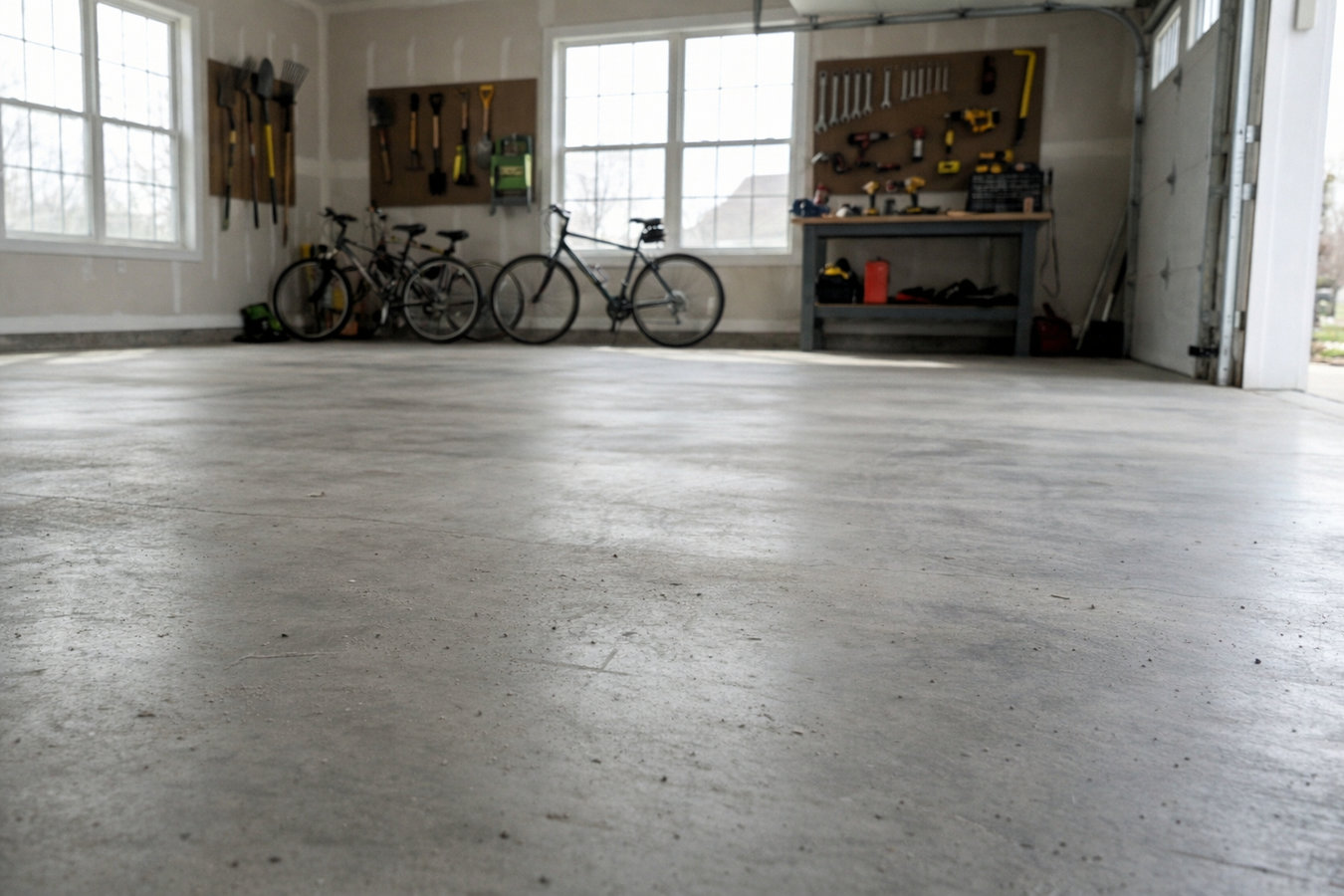
Your garage floor takes a beating from salt air, freeze-thaw cycles, and decades of use. We pour new slabs built to handle Newport winters - with proper base prep, control joints, and the right sealer.
Garage floor concrete in Newport involves removing the old slab, grading and compacting the base, pouring fresh concrete to a level finished surface, and sealing it against salt air and frost - most standard two-car garage jobs are completed in one to two days of active work, with the floor ready for vehicles in about a week.
Newport homeowners face conditions that most concrete guides do not account for. Salt-laden air off Narragansett Bay works on unsealed surfaces year-round, not just during winter. Add in the repeated freeze-thaw cycles that run from November through March, and a garage floor that was never built for coastal conditions can start flaking within a few years of installation.
Many older Newport homes - particularly those built before the 1980s - still have the original thin garage slabs, often poured without the base prep that modern standards call for. If your slab is cracking, uneven, or flaking at the surface, it may be time to look at replacement rather than repeated patching. We also handle concrete floor installation for interiors and additions if your project extends beyond the garage.
If small chips or a powdery layer are coming off the top of your floor, the surface has started to break down. In Newport, this almost always traces to years of freeze-thaw cycles and salt exposure working on concrete that was never sealed - and once it starts, it accelerates.
Hairline cracks are usually cosmetic. But if you can fit a pencil tip into a crack, or cracks run diagonally across the slab rather than in straight lines, the ground underneath has likely shifted. In Newport neighborhoods built on fill or sandy soil near the water, this kind of settling is not unusual in older homes.
A properly poured garage floor has a slight slope so water runs toward the door. If puddles form in the middle or back of your garage after rain, the floor has either settled unevenly or was never graded correctly. Standing water in a garage accelerates concrete wear and rusts anything stored there.
If your home was built in the 1990s or earlier and the original slab is still in place, it has likely lived through hundreds of freeze-thaw cycles and decades of salt exposure. Even if it looks okay on the surface, the concrete underneath may be weakening in ways not yet visible - a contractor can assess quickly whether you need repair or full replacement.
Most garage floor projects in Newport involve one of two paths: full slab replacement, or surface repair and sealing where the underlying structure is still sound. Full replacement means demolishing the old slab, hauling it away, compacting and grading the base, and pouring fresh concrete to current thickness standards. We cut control joints while the concrete is still fresh and apply a sealer rated for coastal conditions once the slab has cured. If you are looking to upgrade the look of your floor at the same time, we can discuss finishing options like exposed aggregate or a troweled surface - and for decorative options like staining or overlays, see our decorative concrete services.
For garages where the slab is structurally intact but the surface has worn or lost its sealer, we can assess whether a reseal or thin overlay makes sense instead of full demo. We will be straightforward with you about which approach is the better long-term investment for your specific situation - and if the ground conditions in your area (particularly in older Newport neighborhoods and lower-lying areas near the harbor) call for extra base prep, we factor that in upfront rather than discovering it mid-job.
Best for floors that are cracked, settled, or deteriorated beyond repair - covers demo, base prep, pour, and sealing.
Ideal for garages being built or converted where no slab currently exists.
For structurally sound slabs that need protection from salt air and freeze-thaw wear.
Exposed aggregate, troweled, or broom-finished surfaces for homeowners who want a cleaner look.
Newport sits on Aquidneck Island, and that geography shapes everything about how concrete behaves here. Salt air off Narragansett Bay is present year-round, and temperatures cycle above and below freezing repeatedly every winter. Every time water gets into a small crack or an unsealed pore and freezes, it expands and enlarges that crack. A garage floor installed without a sealer rated for coastal conditions - or without the right concrete mix - will start showing surface deterioration in just a few winters. This is not a failure you see in warmer inland markets; it is specific to places like Newport. Homeowners in Middletown and Portsmouth face the same conditions on Aquidneck Island and see the same patterns.
Newport's older housing stock adds another layer of complexity. A large share of the city's homes were built before 1980, and many original garage floors were poured thinner and with less base preparation than current standards call for. In neighborhoods closer to the harbor and lower-lying areas, soft or sandy soil beneath the slab is a real factor - it is one of the most common causes of cracking and settling we see when we assess older garages in Newport. Good base prep is not optional here; it is what determines whether a new slab lasts 30 years or starts cracking in five. For any exterior work beyond the garage, we also handle Portland Cement Association -certified mix standards and recommend consulting the American Concrete Institute guidelines for coastal slab construction.
Call or submit a form and we will follow up within one business day. We will ask a few basic questions - garage size, existing slab condition, and your goals - before scheduling a site visit.
We come to your property, measure the space, assess the existing slab, and check base conditions. In Newport, we also look at drainage and soil. You will receive a written estimate that spells out exactly what is included - no surprise line items later.
Before work begins, you will need to empty the garage completely - every vehicle, shelf, and storage bin. If a permit is required, we pull it on your behalf; factor in a week or two for permit approval before the work date is confirmed.
Demo happens first, then base grading and compaction, then the pour - all in a continuous session. Before the crew leaves, we walk you through the curing timeline: walk on it after 24-48 hours, park after seven days, full strength at 28 days.
Free written estimate. No pressure. We reply within one business day.
(401) 344-4828Every concrete contractor in Rhode Island is required to be registered with the Rhode Island Contractors Registration and Licensing Board. Registration confirms a contractor is legally authorized to work in the state, carries required insurance, and can be held accountable. You can verify any contractor's registration before you sign a thing.
We put every project scope in writing before any work begins - demo, base prep, pour, control joints, and sealing are each listed separately. You know exactly what you are paying for, so there are no surprises on the final invoice.
Newport's salt air and freeze-thaw cycles demand more than a standard concrete mix and a coat of whatever sealer is on the shelf. We specify mixes and penetrating sealers rated for coastal New England conditions - because a floor that looks good in June but starts flaking by February is not a finished job.
Older Newport neighborhoods - particularly areas near the harbor and lower-lying streets - sit on fill or sandy soil that requires extra compaction and sometimes a deeper gravel base. We assess base conditions on-site before pouring, not after a problem shows up.
These proof points add up to one thing: a garage floor that holds up through Newport winters without calling us back for repairs. That is what a well-done job looks like here, and it is the standard we hold every project to.
Add color, texture, or pattern to any concrete surface for a finish that lasts.
Learn MoreInterior concrete floors for basements, additions, and commercial spaces.
Learn MoreConcrete season fills up fast on Aquidneck Island - reach out now to lock in your date before summer slots are gone.